History of the USA
From the settlement of the continent to the 250th birthday in 2026.
An Old and a New Nation
The history of the USA is that of both an old and a new nation. Even though the United States will “only” celebrate its 250th birthday in 2026, the settlement of the continent began about 12,000 years ago. Much has happened since then – among other things, 47 presidents have officially been elected since 1789, most recently on 5 November 2024.
The Declaration of Independence and the Constitution of the United States are among the most famous documents in history. Yet before them – and equally groundbreaking – came the Continental Association (1774) and the Articles of Confederation and Perpetual Union (1781).
Milestones of U.S. History
Continental Association
On 20 October 1774, during the First Continental Congress, the thirteen colonies adopt the Continental Association – a trade boycott against Great Britain.
Declaration of Independence
On 4 July 1776, thirteen British colonies in Philadelphia declare their independence from Great Britain; two days earlier, on 2 July, independence had already been declared.
Articles of Confederation
On 15 November 1777, the Second Continental Congress adopts the Articles of Confederation – the first constitutional basis and a precursor of the Constitution.
Constitution of the United States
On 21 June 1789, the Constitution of the United States replaces the Articles of Confederation and establishes a federal republic with a presidential system and separation of powers (checks and balances).
The Star-Spangled Banner
Francis Scott Key writes the poem “Defence of Fort M’Henry”, which becomes the text of the national anthem; the melody is by John Stafford Smith.
Official national anthem
The Star-Spangled Banner officially becomes the national anthem of the United States.
250th birthday
The United States celebrates its 250th birthday – America 250.
Presidents of the USA
The President of the United States (POTUS) is head of state, head of government and commander-in-chief of the U.S. armed forces. So far, 45 men have served as president, out of officially 47 presidencies, with 50 vice presidents. A first: from 2021 to 2025, the office of vice president was held by a woman for the first time.
Continental Association (1774)
During the First Continental Congress, the thirteen colonies adopted the Continental Association on 20 October 1774, which provided for a trade boycott against Great Britain. Cooperation toward a common goal is a long-term success.
Articles of Confederation and Perpetual Union
The Articles of Confederation are the first constitutional basis and the precursor of the 1787 Constitution. The Second Continental Congress adopted the provisions, based on the principle of state sovereignty, on 15 November 1777.
Declaration of Independence
In the founding document of the United States, thirteen British colonies in North America set out their independence from Great Britain and their right to form a sovereign confederation on 4 July 1776 in Philadelphia, Pennsylvania. Two days earlier, on 2 July 1776, they had already declared their independence.
Constitution of the United States
The Constitution of the United States replaced the Articles of Confederation on 21 June 1789 and represents the political and legal framework of the USA. Among other things, it establishes that the USA is a federal republic with a presidential system and that a separation of powers (checks and balances) applies.
The Star-Spangled Banner – Anthem
The text of the national anthem comes from the poem “Defence of Fort M’Henry” by Francis Scott Key from 1814. The melody is by John Stafford Smith (c. 1773). Before The Star-Spangled Banner became the official anthem in 1931, songs such as “Hail, Columbia” and “My Country, ’Tis of Thee” served as anthems on official occasions. The anthem officially has four verses, but only the first is sung.
The Star-Spangled Banner – Flag
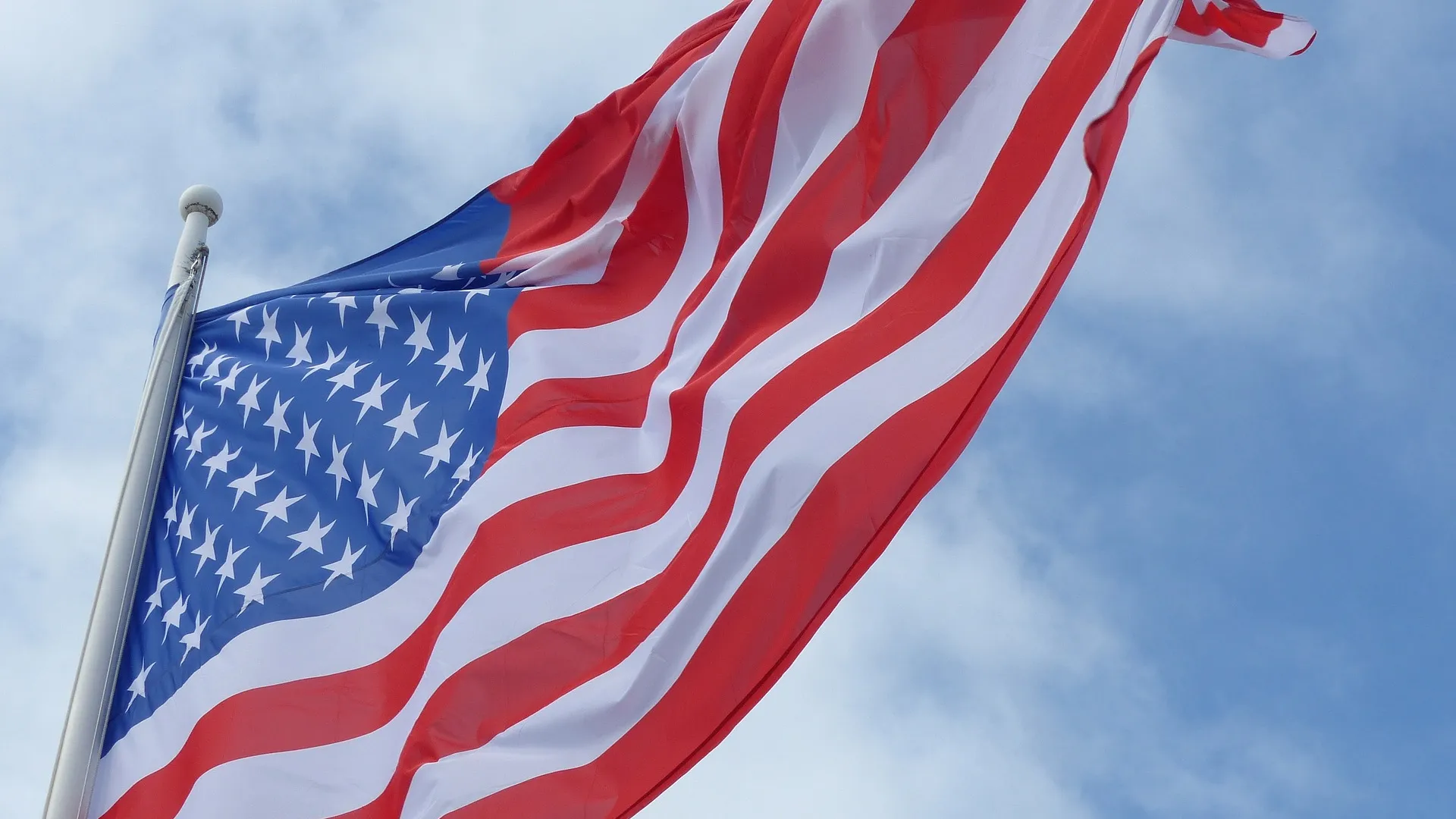
The Star-Spangled Banner, also known as the Great Garrison Flag, flew over Fort McHenry in Baltimore, Maryland, during the War of 1812 and inspired the text of the national anthem. It is the only official flag with 15 instead of 13 stripes. It was sewn by Mary Young Pickersgill and is on permanent display at the National Museum of American History, Smithsonian Institution, in Washington, D.C.
Founding Documents & Topics in Detail
Explore individual chapters of American history in depth:
American Public Holidays
January – June
July – December
All states at a glance
Fact sheets on every state, the federal district and the outlying territories.